
At that point, the business usually wants to find a contractor who can fix everything quickly: remove unwanted content, add positive reviews, and restore an attractive search presence.
There is no shortage of offers built around exactly this demand. Clients are promised a certain number of reviews, publications, comments, and negative links pushed down in search results. A month later, they receive a polished report: this many materials were published, this many responses were prepared, and the overall sentiment has improved. Formally, the work has been completed.
Yet sales often remain almost unchanged. Customers continue to hesitate, negative content returns, and every new discussion becomes another problem.
The issue is not that reputation management has stopped working. The market has simply spent too long selling it as a collection of technical actions, while businesses actually need something very different: a manageable system of trust.
At the same time, the industry continues to grow. According to Mordor Intelligence, the global market for online reputation management solutions and services is estimated at around $7.75 billion in 2026 and may reach $14.01 billion by 2031. This is a forecast rather than audited market data, but the direction is clear: reputation is gradually moving from the category of additional marketing expenses to becoming a full-scale brand management function.
A High Rating Does Not Necessarily Mean People Trust the Brand
A few years ago, reputation management could genuinely be reduced to search results and reviews. A user entered the company’s name, looked through the first few links, checked the star rating, and made a decision.
Today, the journey is more complicated. A person may start with a search engine, then open map services, compare reviews across several platforms, visit the company’s social media accounts, find a discussion on a forum, read comments under articles, and ask an AI assistant for advice. The information found across these sources does not always match.
According to BrightLocal’s 2026 research, 97% of surveyed adult consumers in the United States read reviews of local businesses and use an average of six different platforms during the selection process. At the same time, 41% check reviews every time they look for a company.
The study focuses specifically on US consumers and local businesses, so its figures should not be automatically applied to every market. However, the broader trend is familiar to companies in almost every industry: a good rating alone is no longer enough.
People do not look only at the average score. They check how recent the reviews are, how the company responds to complaints, whether comments include specific details and photographs, and whether the overall profile looks natural.
A page filled with hundreds of similar five-star reviews may raise more questions than a profile rated 4.5 that includes several well-reasoned complaints and thoughtful responses from the brand.
Platforms have also become better at detecting artificial activity. Google, for example, reported that in 2024 alone it blocked or removed more than 240 million reviews that violated its policies. This does not mean that every one of those reviews was paid for, but it does show the scale of moderation and the attention platforms pay to the quality of user-generated content.
Attitudes toward fake reviews are also changing at the regulatory level. In the United States, a Federal Trade Commission rule has been in effect since October 21, 2024. It prohibits the sale and purchase of fake reviews, as well as rewards that depend on a required positive or negative sentiment. Liability may apply not only to the business itself, but also to advertising, PR, and reputation management agencies.
For this reason, the approach of simply “adding more positive content” is becoming both ineffective and risky. A strong reputation must withstand scrutiny. Users should see a coherent and credible picture of the brand, rather than an unnaturally polished showcase assembled over a couple of months.
At US-MEDIA, we take a broader view of reputation. It is not built through one channel, and it does not belong to one team.
Search visibility may be handled by SEO specialists, reviews by customer service, social media by the SMM team, publications by PR, and conflicts by the legal department. Everyone does their own job, but there is often no shared view of the overall situation.
As a result, the brand may respond to the same complaint in three different tones, miss important discussions, and fail to understand which platforms actually influence the customer’s decision.
In one place, the company reacts too late. In another, it uses formal corporate language when people expect a simple human response. Elsewhere, it tries to solve the problem through reviews even though the real issue lies in the product or customer service.
That is why the first stage of the work is not content placement. The first step is to understand where the initial impression is formed, which sources the audience checks, when doubts appear, and who influences the final decision.
For one company, map services may be the key point. For another, it may be the first ten results for a branded search query.
For a complex B2B product, industry communities, case studies, and specialist discussions may matter most. In healthcare, the decisive factors may include reviews of individual doctors, the clinic’s response to complaints, and whether branch listings are accurate and up to date.
There is no universal list of platforms.
This is why the same ORM package for a dental clinic, a real estate developer, an online store, and a corporate IT service will almost always be a compromise. These businesses have different costs of error, different sales cycles, and completely different models of trust.
Where Reputation Management Ends and Guerrilla Marketing Begins
There is just as much confusion surrounding guerrilla marketing. Some still understand it as mass commenting from fake accounts. Others use the term for any native publication. For some, it is simply a cheap way to promote a product without launching a full advertising campaign.
We use a different definition.
For US-MEDIA, guerrilla marketing is a separate layer of native influence that is activated where opinions about a product are formed through discussions, comparisons, and recommendations.
Imagine a company launching a complex new service. Advertising can explain its features and benefits, but potential customers will still want to find out how the product works in practice, how it differs from familiar solutions, and what its weaknesses are.
They will ask questions in professional chats, read comments, look for the experience of other companies, and compare expert opinions.
An official brand account cannot always participate naturally in these conversations. Its answers may be perceived as advertising even when they are completely honest.
This is where an additional layer of work with the information environment may be needed: finding real discussions, identifying recurring questions, preparing clear arguments, and carefully joining the conversation.
It is important not to confuse this with fabricated user experience. We do not consider it acceptable to invent purchases, medical treatment, product use, or other events that never happened.
We do not use mass bot commenting, and we do not create discussions where nobody is genuinely interested in the topic.
Native participation should add value to the conversation. It should explain complex issues, correct factual mistakes, help people compare options, demonstrate real scenarios, and provide additional context.
In sensitive projects, the formats and boundaries of this work are agreed in advance with the client, PR team, and legal team.
This module is not always necessary. In many cases, an official representative, proper review management, and search result optimisation are enough.
Guerrilla marketing is especially useful when a product is new and the audience does not yet understand how to evaluate it. It can also help when a brand is almost absent from relevant discussions while competitors are already actively shaping the information field.
Another scenario involves industries where advertising automatically triggers scepticism and opinions are formed through personal recommendations and professional communities.
However, the result should not be measured by the number of comments published. Two hundred messages prove nothing on their own.
What matters is whether the conversation has changed: whether people are more likely to consider the product, whether comparisons have become more accurate, whether the number of misleading interpretations has declined, and whether branded search demand has grown.
In one US-MEDIA project, a new and unfamiliar product was almost completely absent from relevant discussions. The audience did not understand how it differed from familiar solutions, so advertising messages were met with scepticism.
We analysed the platforms and discussion threads, collected the main questions and objections, and then introduced native participation into conversations that were already taking place.
During the project, the brand appeared in more than 250 relevant discussions, while branded search demand increased 6.2 times.
The most important result was not even the increase itself. The conversation around the product shifted from general distrust to a normal comparison of available options.
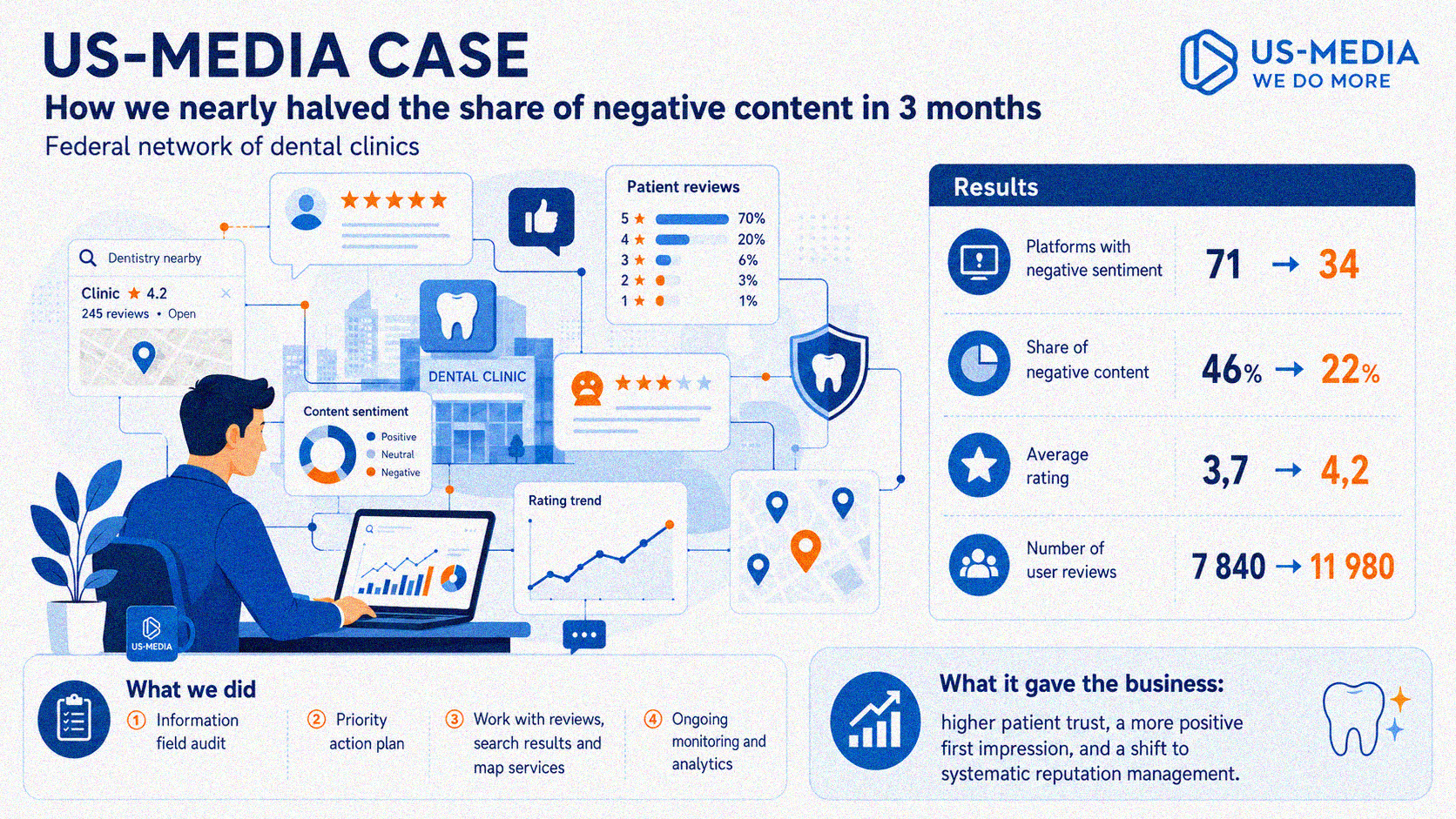
Another project started with negative content occupying up to 80% of the first page of branded search results, while the average rating on key platforms was 3.3.
After the audit, we separated official communications, review management, SERM, and participation in discussions. We identified priority platforms and developed a unified response scenario.
As a result, the share of negative content in the top 10 search results fell to 10%, while the average rating increased to 4.4.
This was not achieved through a single successful publication or a series of reviews. The result came from combining several tools and constantly adjusting priorities.
This is the key difference between a system and a collection of services.
An individual contractor can respond to reviews. An SEO team can manage search results. PR specialists can prepare publications. An SMM team can monitor social media.
But someone still needs to understand how all of these elements affect one another and what overall picture the customer ultimately sees.
We call this an external reputation management framework.
First, the information environment is audited. Then a map of risks, platforms, and scenarios is created. Only after that are the necessary tools introduced: monitoring, review management, map services, SERM, an official brand representative, social media, or native participation in discussions.
Some decisions will always remain inside the company.
An agency cannot change the product on behalf of the client, fix customer service processes, or define the company’s public position in a difficult conflict. But it can identify where the problem is emerging, connect external signals to business processes, and help make the brand’s response consistent.
Reputation today affects much more than whether users like a company.
It influences branded traffic conversion, negotiations, recruitment, repeat purchases, price sensitivity, and resilience during a crisis.
Sometimes the problem appears to be limited to a few negative reviews, while in reality the company is losing customers before they even visit the website or contact the sales team.
That is why reputation management should not begin with the question, “How many positive reviews will you publish?”
It is far more important to understand where the customer makes a decision, what causes hesitation, and which signals are considered trustworthy.
Only then can the company decide whether it needs SERM, review management, an official representative, map services, monitoring, or a guerrilla marketing module.
At US-MEDIA, we do not promise to make the internet sterile or remove everything that makes a brand uncomfortable. That is neither possible nor necessary.
Our task is to build an information environment in which the brand does not appear flawless, but does appear understandable, authentic, and trustworthy.
Ultimately, this influences customer choice far more than a perfect showcase filled with five-star ratings.