
Reputation is one of the key factors behind patient trust in any healthcare organization. Medical clinics are expected to meet high standards of care, but before a patient can evaluate the actual quality of treatment, they often form their first impression online.
Before booking an appointment, people read reviews, compare ratings and check what appears in search results. If negative information is among the first things they see, it can reduce trust and become an additional barrier to choosing a clinic.
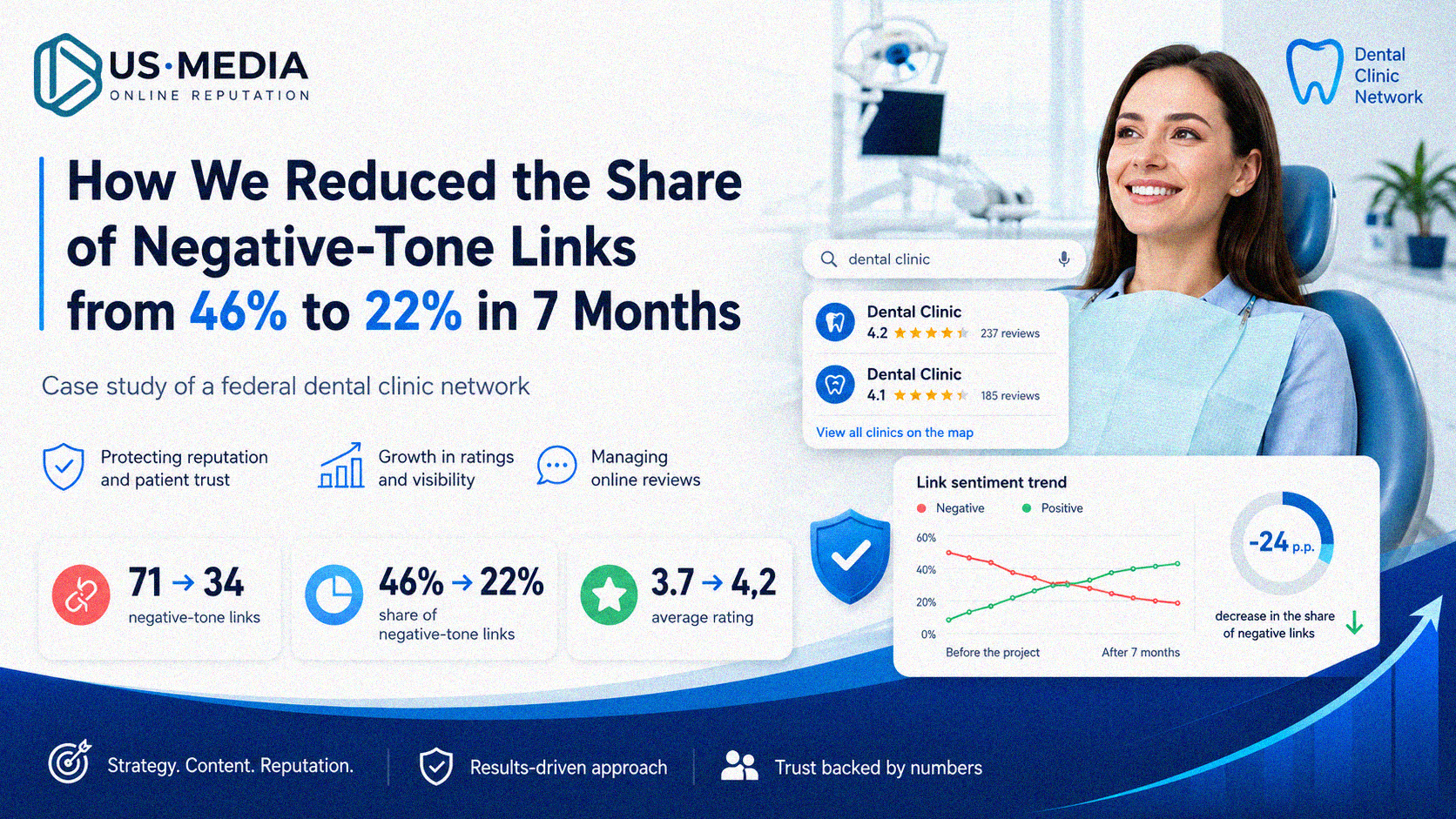
In this case study, we explain how US-MEDIA helped a federal dental clinic network reduce the number of links with negative sentiment by more than half in seven months, bring their share down from 46% to 22%, increase the average rating across monitored resources, and create a more stable reputation landscape.
About the Project
A federal network of dental clinics approached US-MEDIA for reputation management support. Under the terms of a confidentiality agreement, the brand name cannot be disclosed.
The company already had a large volume of reviews and was represented across dozens of platforms where patients could rate clinics and share their experiences.
The main challenge was inconsistency. The brand looked very different depending on the platform, and negative reviews had a strong impact on the overall perception of the network.
The task was therefore not limited to responding to individual reviews. We needed to build a coordinated reputation management system across the broader information environment.
The network operated a large number of branches in Moscow and the Moscow Region. The project covered not only clinic profiles but also individual doctor profiles, since their ratings also contributed to the overall perception of the network.
Where We Started
At the beginning of the project, we analyzed the current state of the brand’s online reputation.
The initial metrics were:
| Metric | Starting Point |
|---|---|
| Links with negative sentiment | 71 |
| Share of links with negative sentiment | 46% |
| Average rating across monitored resources | 3.7 |
A link was classified as having negative sentiment if at least one negative review appeared among the ten most recent reviews when sorted by date.
The share of negative-sentiment links was calculated against the total number of links included in the work plan, including positive, neutral and negative ones.
At the start of the project, 46% of all links in the work plan had negative sentiment. This meant that a potential patient had a relatively high chance of encountering negative feedback at an early stage of choosing a clinic.
For this reason, the team worked across several areas simultaneously.
Project Objectives
The main objectives were to:
- reduce the number of links with negative sentiment;
- reduce the overall share of such links;
- increase the average rating across monitored resources;
- improve the brand’s first impression online;
- move reputation management from isolated actions to an ongoing process.
Results
We did not promise the client an immediate turnaround. The initial volume of negative content was high, while a sudden increase in the number of reviews could have looked unnatural and potentially created additional reputation risks.
The work was therefore carried out gradually over seven months.
By the end of this period, the key indicators had changed significantly:
| Metric | Before | After |
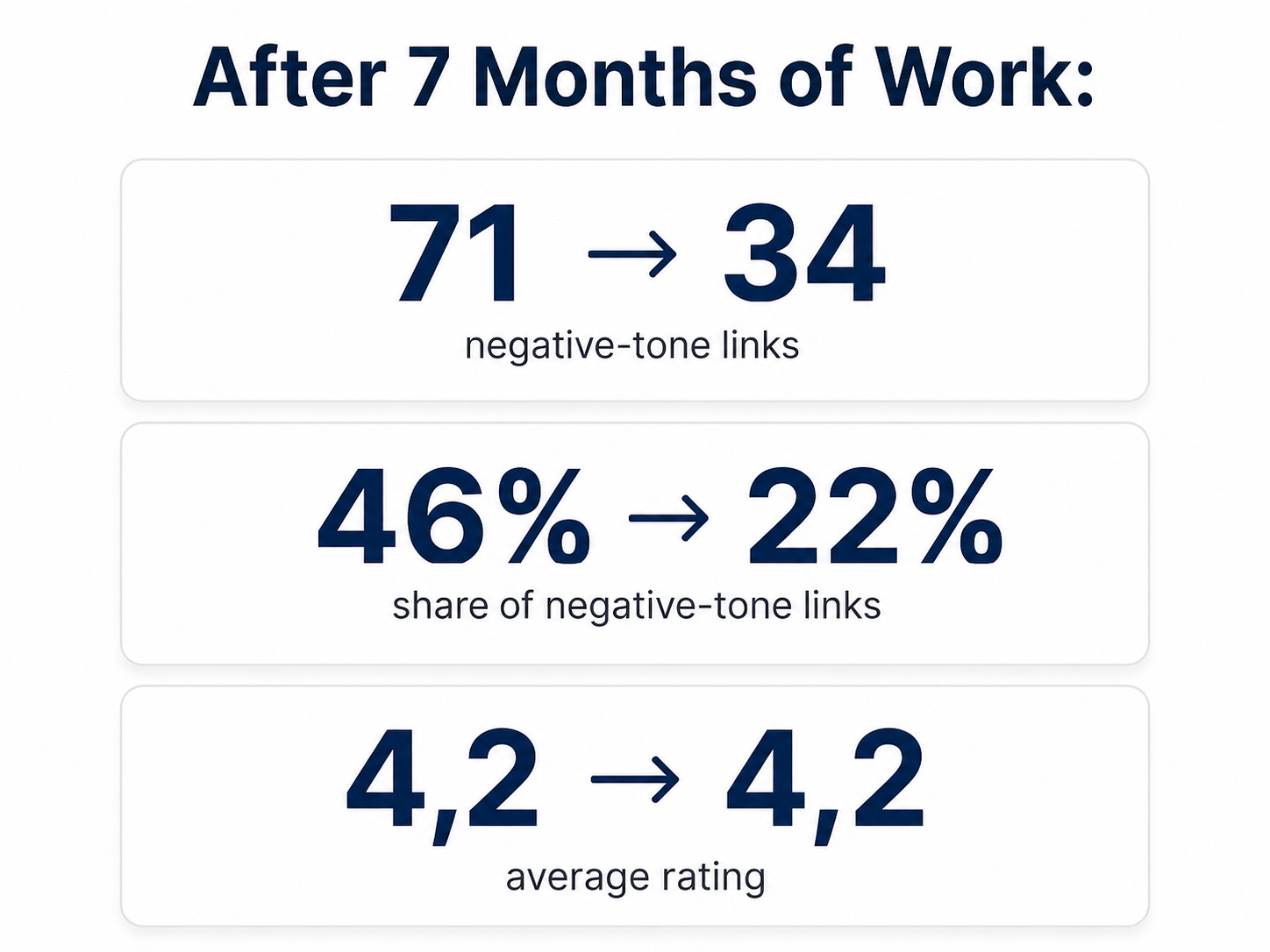
| Links with negative sentiment | 71 | 34 |
| Share of links with negative sentiment | 46% | 22% |
| Average rating across monitored resources | 3.7 | 4.2 |
The number of links with negative sentiment fell by more than half, from 71 to 34.
Their share in the overall work plan decreased from 46% to 22%, making the information environment substantially more favorable for potential patients.
At the same time, the average rating across all monitored resources increased from 3.7 to 4.2, making the brand’s overall reputation profile more stable.
What Drove the Result
The outcome was not the result of a single action. It came from coordinated work across several parts of the reputation environment.
The team:
- focused on priority resources that most frequently appeared in the top 10 search results;
- worked simultaneously with reviews, search results and geo-services instead of treating individual profiles in isolation;
- continuously monitored new mentions and responded promptly to negative feedback on behalf of the brand;
- used weekly and monthly performance snapshots to adjust the strategy throughout the project.
What We Did
Audited the Information Environment
Using Yandex Wordstat, we identified the most relevant search queries and built the semantic core for the project.
We then used monitoring systems to analyze the first 20 Yandex and Google search results for the selected queries and assess their sentiment.
In addition, we requested a complete list of resources controlled by the client and compared it with monitoring data to make sure that no significant platforms were overlooked.
Identified Priority Resources
The collected data was then reviewed with a focus on resources appearing in the top 10 search results.
Irrelevant pages that had no direct connection to the clinic were removed from the work plan. We also excluded resources that were effectively impossible to influence, such as outdated forums with no active moderation or possibility to publish new content.
After cleaning the dataset, the priority platforms were agreed with the client.
Built a Work Plan
Once the priorities were defined, we recorded the current indicators for every link in the plan:
- rating;
- number of reviews and ratings;
- distribution of reviews by score;
- sentiment;
- position of the first negative review.
A reputation calculator was then used to estimate the volume of new reviews required to reach the target indicators.
Based on these calculations, the team created a gradual review-management plan so that changes in the metrics would develop naturally rather than through abrupt spikes.
The work plan also included monitoring of new mentions and prompt responses to incoming negative feedback on behalf of the brand.
The faster the team entered the conversation, the greater the chance of resolving the issue. If the problem was successfully addressed, the user could then choose to update their original rating.
Established Ongoing Reputation Management
Daily work covered reviews, search results and geo-services.
Every week, the team updated the key metrics and adjusted the strategy when necessary.
Once a month, a more detailed review was carried out to assess:
- what had already been completed;
- what remained in progress;
- what actions were planned for the next period;
- what KPIs needed to be achieved.
What Changed for the Brand
Over seven months, the reputation landscape became considerably more stable.
As a result:
- the number of links with negative sentiment fell from 71 to 34;
- their share decreased from 46% to 22%;
- the average rating across monitored resources increased from 3.7 to 4.2;
- reputation management moved from isolated responses to systematic ongoing work.
Conclusions and Recommendations
Effective online reputation management requires a comprehensive approach.
When the initial volume of negative feedback is high, meaningful change takes time. Trying to alter the picture too quickly can create additional risks. A more sustainable approach is to work consistently with priority resources, monitor changes and regularly adjust the strategy.
If negative content is affecting how a company is perceived online, we recommend:
- Regularly auditing the information environment and identifying the platforms that shape the brand’s first impression.
- Working simultaneously with reviews, search results and geo-services instead of limiting reputation management to occasional responses to negative ratings.
- Continuously monitoring changes and adjusting the strategy based on current data.
- Treating reputation management as an ongoing business process rather than a one-time campaign.
This approach helps maintain customer trust and reduce the long-term impact of negative content.
The results described above relate to one specific project. Outcomes depend on the initial state of the information environment, the number of platforms involved, audience activity and other factors. Timelines and performance in other projects may differ.