
Almost every customer checks information about a brand online before calling a company, submitting an inquiry or visiting an office.
They look for reviews, compare prices, read what other people say about the quality of the company’s products or services and form their first impression of the brand before ever interacting with it directly.
No one wants to buy a pig in a poke, so people usually start by reading reviews and other information about the company.
The first links they encounter in search results can have a major impact on how they perceive your business, especially if those links contain outdated articles or random fake negative reviews.
At that point, no amount of relevant, hidden, open, native or any other type of advertising is necessarily going to save the situation.
That is why businesses need to learn how to manage their reputation in search results: it is a direct tool for influencing sales.
What Is SERM?
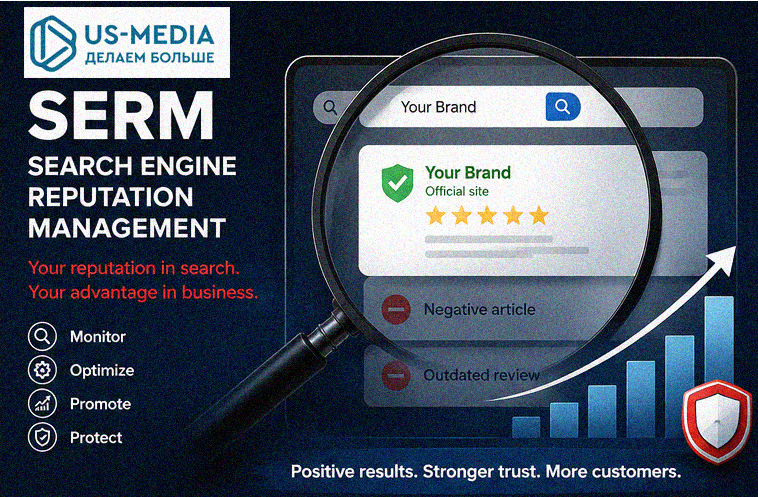
SERM, or Search Engine Reputation Management, is the process of managing a brand’s reputation in search engines such as Yandex and Google, as well as influencing AI-powered search assistants and neural-network aggregators that summarize opinions about companies.
The purpose of SERM is to positively influence search results related to a brand.
In other words, when a user enters any brand-related query into a search engine, the goal is for the top positions — ideally, the entire first page — to contain positive or neutral content about the company, while negative content moves further down the results.
Simply put, SERM aims to ensure that users see a positive image of the brand while negative content is either removed where possible or pushed further out of view.
In most cases, however, the primary goal is to reduce the visibility of negative content in search engines.
How Does SERM Work?
SERM operates at the intersection of SEO and reputation management.
From SEO, it uses content promotion tools: text optimization, platform management and the technical aspects of search rankings.
From reputation management, it takes a focus on the sentiment of publications and on how the company is perceived by its audience.
Unlike traditional SEO, however, the objective is not simply to move a website higher in search results. The goal is to create a coherent overall picture in which every source appearing in search contributes to trust in the brand.
It is important to understand that SERM is not about deleting all negative content. That is impossible and is not always lawful.
All SERM activities must remain within the law. You cannot pressure platforms simply because they host negative content about your company if that content does not violate the law.
Instead, SERM aims to reduce the visibility of irrelevant or outdated materials while strengthening the presence of reliable, current and useful sources: listings on map and location services, articles in industry media, genuine customer reviews and so on.
SERM consists of four main stages.
1. Search Results Analysis
Reputation management in search begins by collecting brand-related search queries.
An SEO specialist compiles a list containing at least the top 20 search results. It is better to analyze the first 20 links rather than a smaller number because search rankings change regularly: a negative page that was ranked 15th yesterday could move up to eighth tomorrow.
The collected links are categorized by sentiment — positive, negative and neutral — and then analyzed to understand which overall attitude toward the brand dominates search results.
2. Strategy Development
Once you understand how your brand is represented in search engines, it is time to build a strategy.
The first step is identifying which types of negative feedback appear most frequently.
A separate content plan should be developed for each major negative topic, with priority given to the issues that have the greatest effect on sales while still addressing the rest.
For example, if people frequently complain that your company misses deadlines or charges excessively high prices, these issues should become a priority.
3. Content Optimization
To build a positive image of a brand online, SEO specialists develop a content plan for future publications.
They select brand-related keywords from search engines and identify recurring phrases appearing in customer reviews.
Based on the audit, the team determines which platforms require the most attention. These may include map services, review platforms or niche forums, although the list does not end there and other resources should also be monitored.
A wide range of content formats can help improve a company’s reputation: social posts, SEO articles, landing pages, case studies, presentations, responses to reviews, company listings and more.
The key is to work with several formats and platforms rather than relying on just one.
Alongside publishing content, the company should also develop a plan for improving its actual service and solving customer problems. Otherwise, the negative reviews and critical articles that you worked so hard to push down may simply return.
It is important not to artificially “clean up” negative feedback. Instead, businesses should encourage genuine customers to share their experiences and communicate appropriately with platform administrators when they encounter false or unlawful content.
4. Monitoring Results
Search results are not static.
Competitors, new reviews and algorithm updates constantly change the way your brand appears online.
For SERM to remain effective, businesses need to regularly monitor the rankings of their content and the overall sentiment of search results — usually once per quarter, or more frequently for seasonal businesses so that the strategy can be adjusted before peak demand.
How Quickly Does SERM Produce Results?
SERM requires patience because it is a long-term process.
The first results may appear within three months, or they may take six months. No one can guarantee an immediate outcome.
It is important to regularly monitor changes in search results and adjust the strategy accordingly.
If you see no positive changes or the amount of negative content increases, you should reconsider your approach.
You may need to change the platforms you work with, select different keywords or examine whether your publications are genuinely honest and useful to users. People are highly sensitive to dishonesty from brands.
Why Is It Important to Control Search Results?
The first links shown by a search engine can shape people’s impressions of your company, product or service before they even visit your website.
Most people only browse the first few pages of search results, yet the image they form based on those links may become more firmly associated with your business than reality itself.
If the top results are dominated by neutral or contradictory information, potential customers may be left with a sense of uncertainty even if there is relatively little actual negative information about the company.
Well-managed search results function like a storefront. They demonstrate that the company is open to communication, has genuine customers and maintains a solid reputation.
Controlling search results can also help protect a business from competitors’ information attacks and sudden waves of customer dissatisfaction.
A company that systematically manages its search reputation can respond to such situations faster and with fewer losses because it already has a foundation of stable, positive content capable of balancing isolated spikes in negative attention.
What Results Does a Business Get?
Better Audience Retention
SERM increases trust among customers who are already interested in a product but have not yet decided whether they want to buy from a particular company.
It can help move these customers closer to a purchase and strengthen their confidence in the brand.
Less Public Negativity and Higher Conversion
Negative search results directly affect the number of users who drop out after their first contact with a brand.
SERM aims to reduce the visibility of such negativity by strengthening positive and useful content.
When users see an up-to-date, useful and positive picture of a company in search results, they are less likely to abandon the customer journey at the awareness stage.
Over time, this can lead to more inquiries, phone calls and applications.
The Business Learns What It Needs to Improve
There is also a secondary benefit that businesses often overlook.
Analyzing genuine reviews and questions appearing in search results helps companies identify weaknesses in their service or product before those issues become widespread.
In this sense, SERM works not only on the company’s external image but also as a feedback mechanism for internal improvements.
By the way, if you are already thinking about managing your reputation in search engines, the US-MEDIA digital agency will be happy to help you with it.
Conclusion
Search results are a content environment that shapes customer trust in a brand.
And just like a real field, this environment needs to be monitored and maintained, because what is at stake is not simply comments from random people online, but the company’s sales and reputation.
SERM exists to make this process systematic rather than chaotic.
It gives companies greater control over which materials appear at the top of search results and allows them to systematically build a brand image in search engines that helps attract and retain customers.