
Of all the types of marketing known today, guerrilla marketing probably sounds like one of the most niche. It may seem as though everyone has heard of it, but only a handful of marketing specialists truly know how to do it, while only brands bold enough to joke around within their own content strategy actually use it. Yet, in reality, only the name is niche.
People encounter guerrilla marketing all the time: when they take a picture of unusual graffiti or laugh at a company’s witty reply on social media. No one usually says, “Look at this great example of guerrilla marketing.” Instead, people say something like, “Wow, look what they came up with.”
How Does Guerrilla Marketing Work?
In broad terms, guerrilla marketing refers to unconventional ways of communicating with people and users that attract attention while requiring relatively low spending on promotion and media placement. Both large corporations and small businesses can run such campaigns. In other words, guerrilla marketing can work for companies of almost any size.
Most of the time, it is built around a strong idea that, in a sense, works on its own. A brand only needs to notice a habit, trend, location, or another opportunity to engage with its audience and add an unusual — or at least clear and engaging — mechanic.
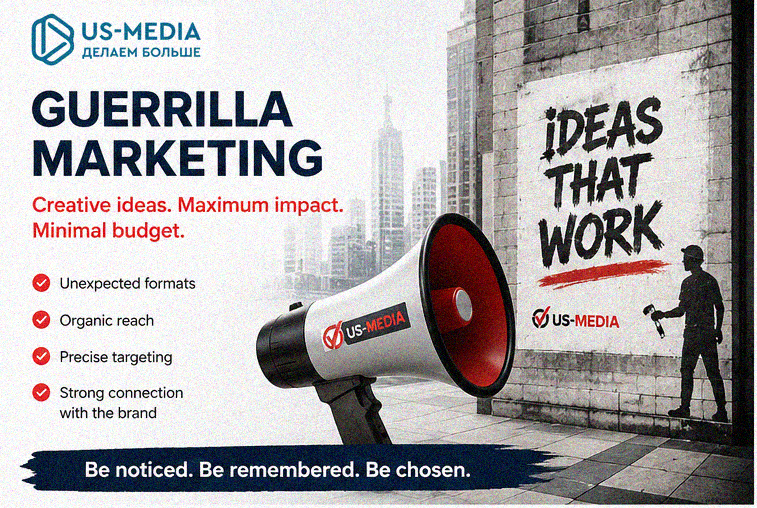
The entire methodology is based on several principles:
Unexpectedness
Communication appears in an unexpected place or format. For example, a company may reply to users’ Telegram comments with voice messages.
Organic sharing
People want to share the result of the campaign or at least take a photo of it as a keepsake.
Precision
The idea or communication is designed specifically for a particular audience.
Connection to the brand
Every activation should be based on the company’s brand platform and feel natural within it.
Guerrilla Marketing Formats
As you might expect, in today’s fully digital world, campaigns can take many forms. Twenty years ago, guerrilla marketing was mainly associated with offline activations — for example, turning the white stripes of a pedestrian crossing into French fries. Today, guerrilla campaigns can be divided into several formats.
Offline Campaigns
These campaigns work with the physical environment. They include installations, street objects, signs, graffiti and, essentially, almost anything else.
For example, an air-conditioning manufacturer or retailer could install a billboard or posters designed to look as though they have “melted” in the summer heat.
Online Campaigns
These appear on social networks, messaging platforms, websites and other digital channels. Their main mechanics include comments, publications, challenges and virtually any other type of community-oriented content.
In 2026, for instance, it has become especially popular for brands to enter the comment sections of larger companies and post humorous replies from their corporate accounts, which can later go viral in other communities.
Hybrid Mechanics
These combine the two approaches described above.
Imagine a coffee shop placing an enormous coffee cup in a city street. It seems to appear out of nowhere and becomes a local landmark for several days. Anyone who takes a photo of the installation can then receive a discount at the coffee shop.
How Is Guerrilla Marketing Different from Hidden Advertising?
Intuitively, these two types of promotion may seem almost identical, but there is an important difference. It comes down to authorship and transparency.
With hidden advertising, the commercial nature of a message is intentionally disguised. In guerrilla marketing, however, a business usually does not hide the fact that it is behind the communication. Instead, it is the advertising format itself that remains unusual.
Confusion arises when a brand deliberately buys reviews or comments and presents them as genuine initiatives from ordinary people. That is already hidden advertising — and if the manipulation is exposed, it can seriously damage the brand’s reputation.
Where Does Guerrilla Marketing Work Best?
Such campaigns tend to perform best where the audience is willing to take some form of action — from leaving comments to participating in an activation.
Examples include food service, FMCG, sports and esports, tourism, technology and similar industries.
Guerrilla marketing can work at almost any stage of a brand’s life cycle. Launching a new product? Great. Supporting an existing one? It can work just as well.
Guerrilla marketing is particularly relevant online. Brands can join existing discussions, influence how people perceive trending topics, adapt memes and use other community-driven formats. Comments are one of the most common tools here, and they can directly affect both brand reputation and the overall “vibe” around the company.
The main thing brands need to remember is naturalness. Communications should be understandable and authentic rather than artificial or looking like traditional, overly polished advertising. Brands should not be afraid of appearing less than perfect.
If a company simply copies the communication patterns of other brands as part of its online guerrilla marketing strategy, people will notice almost immediately.
It is also important to understand that guerrilla marketing can work in the B2B sector. For example, brands can use unconventional approaches at professional conferences or within industry discussions, offering unexpected tools for solving business problems. The key is to give professionals useful or entertaining material that they will want to share with colleagues.
At the same time, guerrilla marketing may be less effective in industries where formal and restrained communication is still expected — such as healthcare, finance, security or sensitive social topics.
What Risks Does Guerrilla Marketing Involve?
One of the biggest risks is that the audience remembers the mechanic or the idea but fails to associate it with a specific brand.
This happens when the company name or logo gets lost in the execution or when the idea itself has little connection to the product.
For example, if you run guerrilla marketing on social media for a sports brand, suddenly trying to participate in discussions about oil refining would probably feel strange and out of place.
Online guerrilla marketing is also a game where a single mistake can have long-lasting consequences. Brands enter live conversations where fast reactions are essential, while every unsuccessful joke or poorly judged response can remain online forever.
One inappropriate meme may be enough to create a reputational problem that takes years and considerable resources to repair. This is why teams need clearly defined boundaries and strict editorial guidelines before entering such conversations.
Legal risks should also always be considered. Brands should not cross ethical boundaries, insult people or violate the laws of the Russian Federation.
How Should the Results of Guerrilla Campaigns Be Evaluated?
Every marketer knows that evaluation begins with goals. Metrics therefore need to be defined before the campaign launches. Otherwise, virtually any reach figure can be presented as a success — while marketing is supposed to deliver measurable results.
A basic framework may look like this:
Define the primary objective
This might include increasing brand awareness, creating a new brand association, driving audience engagement or improving brand reputation.
Check the connection to the brand
After the campaign, you can conduct a survey, track changes in branded search volume or analyze mentions of the brand on social media.
Separate the quality and quantity of reactions
When evaluating the campaign, consider organic posts, media mentions and user-generated content. Sentiment should also be taken into account. If a campaign receives a large number of angry reactions on social media, something has clearly gone wrong.
For reputation-focused guerrilla campaigns, comments should be analyzed separately.
Reactions can be collected under brand publications in media outlets, reposts, online communities and other environments.
Most importantly, this type of work should be viewed as a long-term game. Such projects may last at least six months, because only over time can the real effect on brand perception be evaluated.
Guerrilla marketing is not simply a collection of meme-based activations or another form of hidden advertising. It gives brands more freedom and allows them to move beyond traditional PR and marketing tools, both offline and online.
The key is to maintain the right balance between creativity and feasibility, as well as between short-term tactical success and the company’s broader strategy. When that balance is achieved, guerrilla marketing can make a positive contribution to brand reputation.